
In October 2013, after finishing my PhD in Vancouver, I had moved to Toronto for a few months to launch my second startup. Coming from a meeting with an investor, I took a picture of a pretty plant. I was hopeful that I would launch a company worth $1B by 2023. That startup dream failed. My internal mood was not too dissimilar to this scene from the movie Gladiator! Well, I started a new one in 2020.
Over the past three years, I have been trying to launch a startup. I've launched several experiments and MVPs but haven't been able to sell anything yet. Here's my journey and what I've learned so far.
Chapter 1 — Ideation
In the fall of 2019, I began my third attempt at building a company. The journey started with my participation in the Entrepreneur First program, which I highly recommend. This program comprises a cohort of people with various backgrounds; within three months, you need to come up with an idea, find a team, and launch a startup. If you can form a team among the cohort and develop a solid idea, you'll pass an internal demo day, receive a small funding, and can continue to build and raise your seed. If not, you go home. To be honest, this was not too dissimilar to the Gladiators either!
For ideation, they use a methodology called edge-based ideation. The principle is that you should focus on your most valuable skill, something at which you excel, and combine it with the skills of your co-founders. This way, you can achieve the right founder-market fit.
I reflected on my skills and areas where I have an edge compared to other potential founders. I excel in mathematical modeling, having spent ten years of my education, from BSc to Ph.D., building computer models of thermodynamics and structural evolution in solid-state systems, with publications that won awards. Furthermore, I spent another ten years leading data science teams in startups and scale-ups.
However, societal matters have always captivated me. I find it unbearable to see the world suffering from systemic injustice, poverty, and violence we have today. You may think these are philosophical, cultural and political challenges but in a practical sense they are socio-economic issues. They are about how we allocate resources and which economic, financial, and organizational choices we make. They are about how individuals, and institutions as agents interact and utilize their resources and environment.
What can a computational scientist and techie do in this area? If we provide a new framework of thought where people can rationally assess the world and the impact of certain paths, we empower them to identify the best scenario and advocate for it. If we have a digital twin of the socio-economic system we live in, we can understand the current world, simulate various alternative worlds, and construct a vision of the future we desire.
Consider an individual and how they allocate their financial and life resources. What career do they choose? Where do they work and invest? How do they take risks or spend money? These financial decisions fundamentally shape our lives.
Corporations make decisions based on business cycles, often making mistakes by under-investing, over-hiring, or laying off people out of fear. Also think about governments on how they must decide how to allocate capital and resources. Are these entities choosing the most rational direction?
So the idea is that people are suffering from irrationality and among other things, they need a digital twin, a computational model of society, to help them overcome the pain points they face.
Chapter 2 — First Prototype: MarketsReplica.com
I had experimented with agent-based models of the economy back in 2013, winning a hackathon by building a model that could forecast real estate prices in a model village. I came across a groundbreaking publication by Sebastian Poledna, a physicist turned economist, titled "Economic Forecasting with an Agent-Based Model." This paper demonstrated for the first time how a digital twin model containing millions of agents and firms could replicate an entire country.
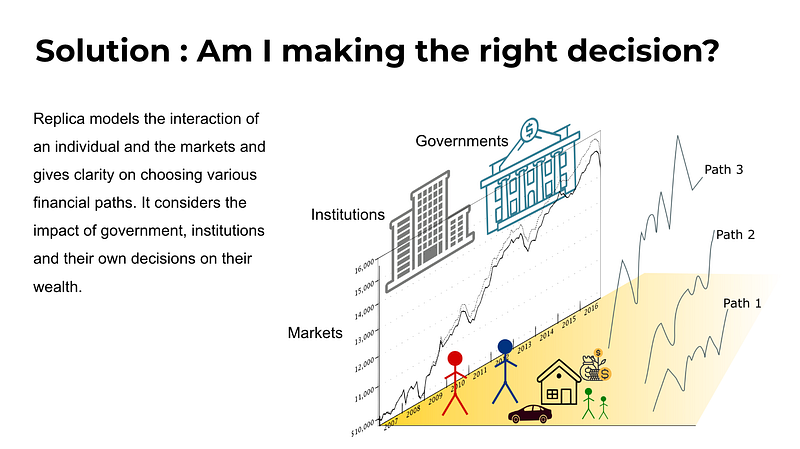
Our initial idea was to commercialize our research. We held discussions with numerous firms, from S&P Global and Moody's to banks and hedge funds. We discovered that larger corporations didn't prioritize having a superior model of the economy, especially if it was developed externally. There also existed a psychological hurdle for decision-makers, such as lead economists, who found it challenging to admit the need for a startup's assistance in their roles.
So as a major pivot, I recognized that individuals, not corporations, were the ones most in need of access to mathematical models of finance and economy. They lacked access and often made mistakes due to a lack of understanding of the economic environment. As a result, I shifted focus to the personal finance space.
Chapter 3: A Financial Model for the Masses — ExpensiveDecisions.com
In the meantime, I was also looking for teammates. I found a co-founder networking online. We wanted to test the hypothesis that people want access to financial models. We developed a simple experiment: a spreadsheet model of buying a house versus renting, which we featured on our website, ExpensiveDecisions.com. The website allowed visitors to input their email and to gain free access to the model in Google Sheets.
In essence, this was a more sophisticated version of a popular rent versus buy calculator. It evaluated personal portfolios and compared the two scenarios: investing in real estate versus the financial market.
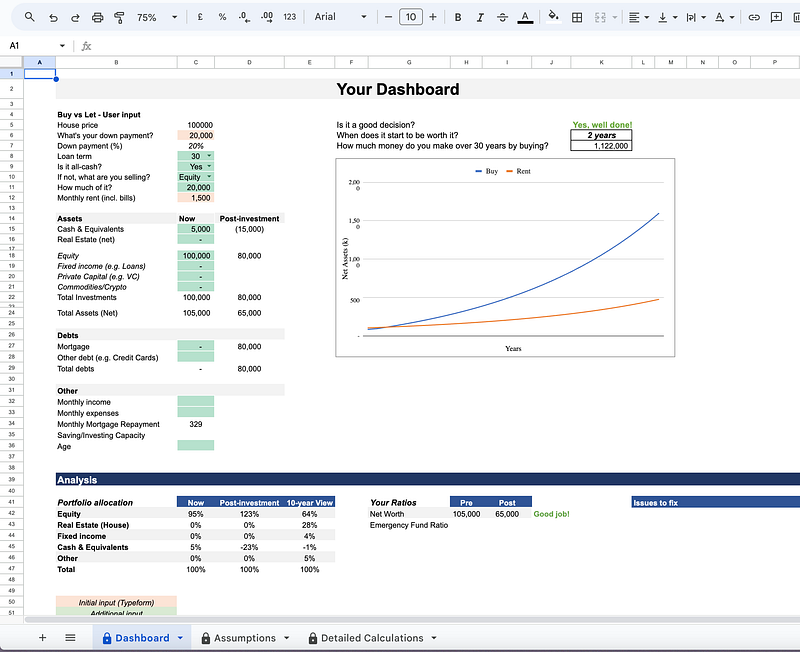
We drove traffic to the site through search ads and social media. Out of every 100 visitors, only ten received the model, and merely one was willing to discuss their experience with us. The reality was that, except for that 1% who happened to be a developer and enjoyed playing with Excel, nobody really wanted an Excel model. After this failure, our team disbanded, and I embarked on a new experiment to simplify the product.
Chapter 4: A Computable Financial Blog — MillionMore.me
People are accustomed to finding information through blogs and articles. Currently, billion-dollar web properties like NerdWallet and Investopedia serve just that purpose.
In my mission to make mathematical models of finance more accessible, I began working on a prototype where a user can enter their financial data into numerical fields on a blog-like page. A financial model running in the background updates the text in real-time, personalizing the blog for each individual user as they input their data.
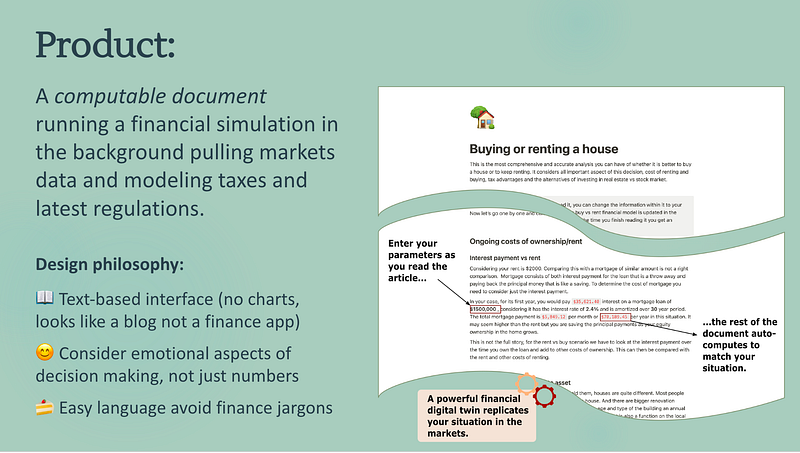
The feedback I received after launching this was varied. One key point was that people wanted to see outcomes visually. Pure text was not the best format. Also, the rigid nature of the blog did not provide people with the flexibility to modify the content. More importantly, people's questions and pain points varied. I realized people didn't care so much about whether they should make a specific decision (they already want to buy a home), but they needed to conduct risk assessments about it or argue and convince others about a particular action. They didn't need me to tell them what the most optimal choice was. Instead, they wanted to convince themselves or their partners that the choice they had already made was sensible. This was the real pain point that I discovered after the launch: the financial model as a communication tool.
The product's reception was lukewarm at best. I tried to pitch this as a B2B2C concept for say mortgage brokers to use for their clients. After 50 cold emails, one response, and zero traction, I came to understand that the narrative wasn't resonating with people. Investors suggested I determine whether my focus was B2C or B2B2C and they wanted to see traction. This was mid 2022 and investments in startups came to stand still except for ones with good traction. Meanwhile, my new co-founder relationship was largely unproductive. My first Y Combinator application got rejected.
It was a time to pivot both the team and the idea.
Chapter 5: A no-code financial model with ChatGPT integration — PlanwithFlow.com
I have been inspired by an indie hacker who built a product in a very similar space: Projectionlab.com. He got to $100K ARR last month after 2 years from launching. So this shows that there are people out there who pay for building a lifetime financial model. These are mostly people interested in Financial Independence and Retire Early (FIRE). There are communities with hundreds of thousands on Reddit dedicated to the topic.
Financial planning tools also exist for advisors or on sites like PersonalCapital.com. So, if I could develop a product with greater flexibility and a more user-friendly interface, it should prove successful.
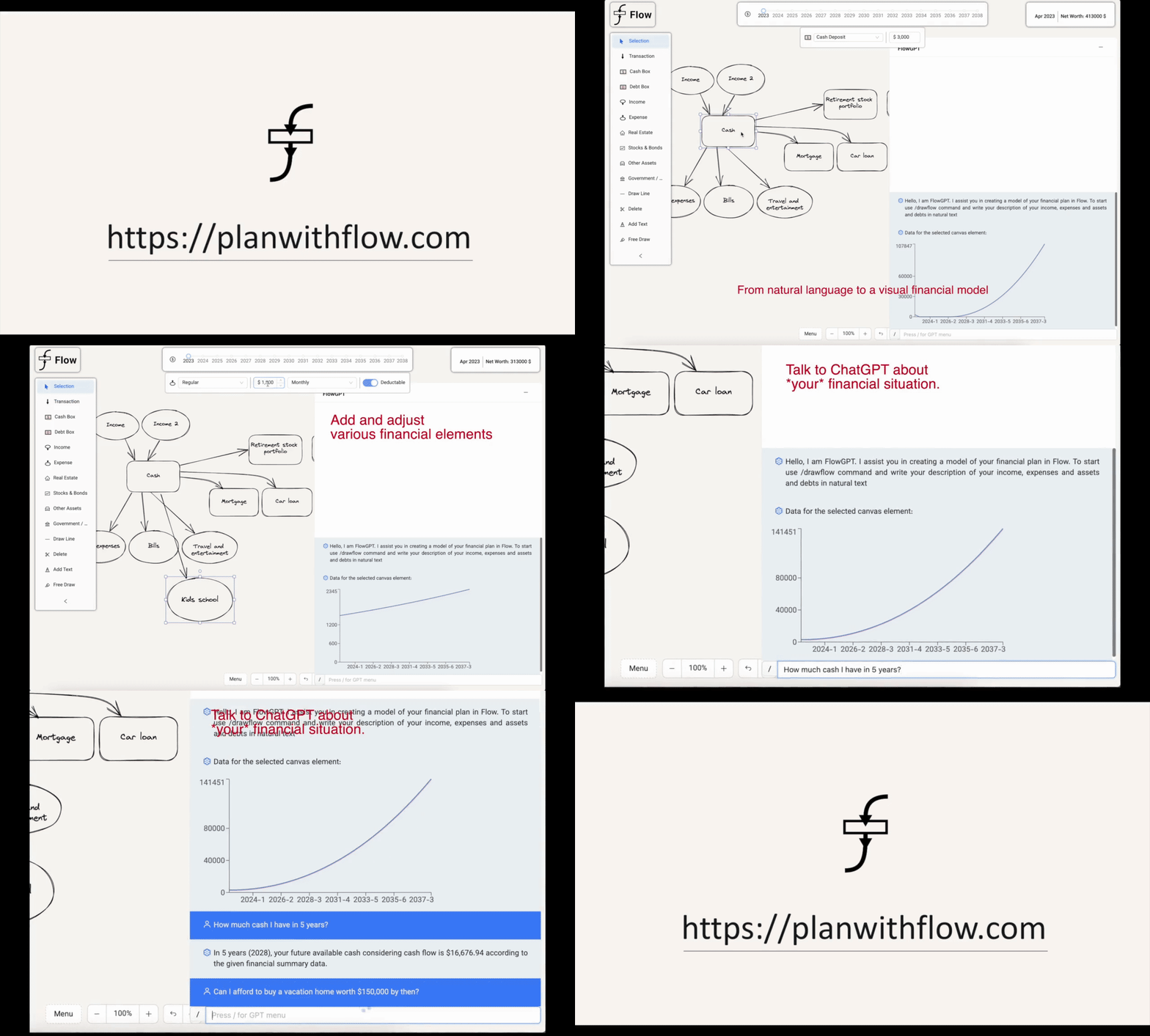
So myself and a front-end dev friend have been working on this for the past 8 months writing 30K lines of code. It took too long probably to conduct an experiment but given the complexity of the product, it had to be in good shape before it can be used.
Our first launch was Feb 2023. In the midst of it, the world changed when ChatGPT was released. It didn't dawn on me until a day after GPT4 was launched, and I realized how adeptly this tool could reason. Suddenly, I found the perfect complement to the vision I had with mathematical models; The barrier that my potential customers faced with the original Excel model was the inherent inaccessibility of financial models. My idea to use a no-code environment still faces the obstacle that people need to learn the language of the modelling, even in a no-code tool. However, this barrier can be mitigated if they are assisted with a language model and its reasoning and knowledge capabilities. This should unlock massive adoption of the tool.
At the time of writing this passage, the jury is still out on whether my latest experiment will show evidence of product-market fit. The narrow beachhead market that I am focusing is for people who aspire to FIRE, and the product is a financial model with a no-code/ChatGPT interface. Does this have a product-market fit…
My vision ultimately is that every individual household in the world would use this tool on a monthly basis to observe, discuss and make plans. This combination of mathematical and language models is a tool that fundamentally augments our capability to be more rational and together with our empathy drives our societies to be more just, more fair and more prosperous.